Reclaim Democracy!

  • Home
  • Issues
    • The Right to Vote
      • U.S. Voting History
      • 50+ Ways to Disenfranchise or Suppress Voters
    • Corporate Personhood
    • Citizens United
    • Direct Democracy
    • All Topics
  • Resources
    • Ed Board Meetings
    • Letters to the Editor
    • Op-eds
    • Presentations & Workshops
    • Talk Radio
    • Tools for Activism
  • Donate
  • About
  • Contact

Archives for November 2012

Amazon Plays Hardball on Tax Avoidance in Texas

November 30, 2012 by staff

The following is excerpted from “Lines Blur as Texas Gives Industries a Bonanza,” part of a series on corporate tax incentives in the New York Times. Published December 3, 2012 
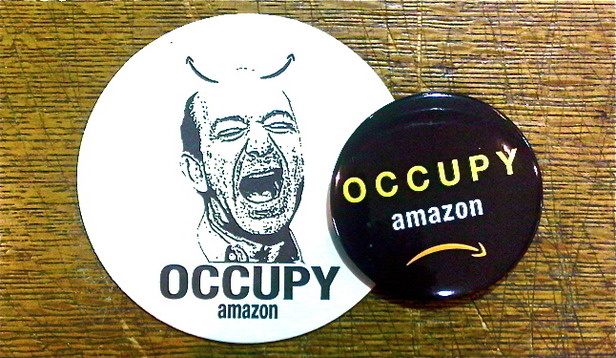
Tarik Carlton gathered with other workers in February 2011 to hear the bad news: Amazon was shutting its distribution center in Irving, where he loaded trucks for $12.75 an hour.

Business had been strong, but the online retailer did not want to pay a $269 million tax bill from the state comptroller. A standoff with the state ensued, and Amazon laid off the workers. “They didn’t have our interests in heart, truth be told,” Mr. Carlton said.

Amazon opened the distribution facility in 2005 in Irving, near Dallas-Fort Worth International Airport, and local officials awarded the company tax breaks on its inventory.

Positions at the warehouse included product pickers, dock crews and truck loaders. The employees were typically on the young side, and some had served in the military. The warehouse churned through workers because many could not meet the quota of products they were supposed to move each day, according to Frankie Lloyd, who helped Amazon find temporary workers to fill many of the jobs.

“It’s all about what you can do physically,” Ms. Lloyd said. “Like manufacturing, but without the great pay.”

The distribution business grew as manufacturing moved overseas and online shopping boomed. It is big in the Dallas area because two main train lines run here from Long Beach, Calif., where goods arrive from Asia.

The work is highly physical. One Amazon worker wore a step counter that logged five miles during one shift, according to Mr. Carlton, who only recently found a new job. He was among 12 former Amazon workers, including two warehouse managers, who agreed to be interviewed.

There was no air-conditioning in the warehouse, and Mr. Carlton and others said the temperature could reach 115 degrees. They said it was difficult to take breaks given the production quotas.

The pay was typically $11 to $15 an hour, Ms. Lloyd said. Amazon gave out small shares of stock and some bonuses, but the amounts were minimal, she said.

Amazon said it had been working to upgrade its warehouses, which it calls fulfillment centers. The company has installed air-conditioning in all its centers over the past year, said Dave Clark, the vice president for global customer fulfillment.

Mr. Clark said workers always received breaks, and sometimes free ice cream when the facilities did not have air-conditioning. He said the quotas were akin to “expectations that go along with every job, mine included.”

“I really do think these jobs get a bad rap,” Mr. Clark said. “They’re great jobs. They’re safe jobs.”

Mr. Carlton said he had no idea the company was being partly subsidized. “If you give them money, I think more should be expected,” he said, adding that Amazon should have been required to hire more people to handle the heavy workload.

John Bonnot, the director of business recruitment for the Irving Chamber of Commerce, said the city did not impose wage or benefit requirements on companies that received incentives. Irving had required that Amazon create only 10 jobs to receive the tax break.

Mr. Bonnot said Amazon “would have nothing but praise” for the original assistance from the state and the city, which outsources its economic development to the local chamber.

Things began to slide downhill in late 2010 when the state comptroller, Ms. Combs, demanded that Amazon pay the $269 million sales tax bill. The retailer had never charged its Texas customers the tax, giving it an advantage over on-the-ground competitors.

The company hired three powerful advocates with ties to the governor, according to state lobbyist disclosure records. One, Luis Saenz, had been the director of Mr. Perry’s political operation. Days after the warehouse closed, Mr. Perry said he disagreed with the comptroller’s decision to demand the taxes.

“I was the last person besides the site leader and the administrative assistant to leave the building. It was sad for me because I had gotten my family, my grown kids, to move to Dallas with me, and I didn’t want to transfer back and leave them.”

As it was battling with the comptroller, Amazon began negotiating with the Legislature, which was debating whether online businesses should be required to charge sales tax. The company told lawmakers that it would create up to 6,000 jobs in exchange for delaying sales tax collections, similar to a compromise it had struck in states like South Carolina and Tennessee.

The lawmaker with the most power in the decision was John Otto, a Republican member of the Texas House of Representatives. Like all Texas legislators, Mr. Otto’s government job is part time. He also works at Ryan LLC — a job that is not disclosed on his legislative Web site.

Mr. Otto drafted legislation that said online retailers like Amazon would not have to charge sales tax as long as it did not have distribution facilities in Texas. By then, the company had already shut the Irving warehouse.

Mr. Otto and Mr. Saenz declined to comment about the legislation. Amazon would not comment on its negotiations with Texas.

In July, Amazon began collecting sales tax from customers in Texas after the comptroller agreed to release the company from most of its $269 million bill. The company has also promised to open new distribution facilities and hire 2,500 workers. Amazon will owe the state a $1 million penalty if it fails to deliver.

[pullquote] For Texas to give up more than $250 million in tax revenues in exchange for 2,500 jobs amounts to about $100,000 per job.[/pullquote]

The math on the new deal angers former Amazon workers, especially those who are still unemployed. For Texas to give up more than $250 million in tax revenues in exchange for 2,500 jobs amounts to about $100,000 per job. Most distribution workers are paid $20,000 to $30,000 a year. The rest benefits the company’s bottom line, which generally increases executive bonuses and shareholder returns.

King White, a consultant who helps Amazon choose locations, would not comment on the online retailer but said that companies in general had come to view incentives as entitlements. “Everybody thinks they deserve something,” Mr. White said. “ ‘If I’m creating jobs, what’s in it for me?’ ”

The deal on the sales tax did not require Amazon to reopen the Irving facility. That touched off the latest state competition to win over Amazon.

Last month, the city of Schertz beat out neighboring San Antonio for one of Amazon’s warehouses. The company is currently in negotiations with Coppell, outside of Dallas, about an additional center. Like Schertz, Coppell has offered Amazon a deal to keep a part of the sales tax it collects there, among other incentives.

If Amazon accepts, it will be located near Irving and many of its former workers. Sharon Sylvas, 47, had moved from Kansas seven years ago to help Amazon set up the Irving facility. She lives nearby in a one-bedroom apartment with her partner, daughter and two grandchildren.

After Amazon closed, she was out of a job for over a year. With limited options, Ms. Sylvas took a temporary position in October at another company’s distribution center. It is a tougher job than the one at Amazon, and it pays less. For $11 an hour, Ms. Sylvas moves heavy inventory and other items.

She said that if Amazon returned to the area, she would work there again, despite the rigors of warehouse jobs. “It’s real miserable,” Ms. Sylvas said. “But you do it to make a living.”

Image courtesy of John Stich via Diesel.

See also
Amazon Bolts Texas (Columbia Journalism Review)
Amazon Picks U.S. State Sales-Tax Winners (Business Week)
Amazon’s Physical Presence in U.S. and the Sales Tax Battle (American Independent Business Alliance)

Filed Under: Corporate Welfare / Corporate Tax Issues, Free Trade, Independent Business, Uncategorized

Surprise! Citizens United Legal Reasoning Doesn’t Rely on Corporate Personhood

November 11, 2012 by staff

By Nick Bentley
Published November 11, 2012

For anyone who opposes excessive corporate influence over government, these are encouraging days: there’s now a widespread groundswell of support across the country to overturn Citizens United and deprive corporations of their improper status as “people”.

However, we’ve noticed a misconception spreading that Citizens United is an extension of corporate personhood. It’s not.

It’s true that Citizens United strengthened First Amendment protections for corporations. But the basis for that protection isn’t corporate personhood. Rather, the court’s decision rests on two other assumptions:

  1. That money equals speech; and
  2. That non-persons have the right to speech.

That second point is the kicker. If corporate personhood ended tomorrow, it wouldn’t affect Citizens United at all, because non-persons have speech rights now too. If your underpants could talk, they would be protected by the First Amendment.

How do we know this? First, look at some relevant text in the majority opinion, written by Justice Kennedy:

Premised on mistrust of governmental power, the First Amendment stands against attempts to… distinguish among different speakers, which may be a means to control content.

In other words: the identity of the speaker is irrelevant. Justice Scalia drives this point home in his concurrence:

The Amendment is written in terms of “speech,” not speakers. Its text offers no foothold for excluding any category of speaker, from single individuals to partnerships of individuals, to unincorporated associations of individuals, to incorporated associations of individuals—and the dissent offers no evidence about the original meaning of the text to support any such exclusion. We are therefore simply left with the question whether the speech at issue in this case is “speech” covered by the First Amendment.

Justice Scalia stresses that the First Amendment doesn’t exclude “any category of speaker,” The First Amendment protects anything that speaks, whether it’s legally a person or not.

This is a key point for those of us who hope to reign in excessive corporate influence through a constitutional amendment. It’s not enough to merely revoke corporate personhood. To overturn Citizens United, we also have to overturn the two assumptions listed above.

Luckily it’s not difficult get the language right. Both Reclaim Democracy and Move to Amend have proposed amendments which would do so. For example, rather than simply establish that “Corporations are not people,” Reclaim Democracy’s amendment specifies that “the U.S. Constitution protects only the rights of living human beings.”

It’s a small difference in language with big implications. Let’s make sure that all who advocate for an amendment understand the distinction.

Resources
  • Our comprehensive overview of corporate personhood
  • Our introduction to Citizens United
  • Our proposed constitutional amendments
  • Personalizing the Impersonal: Corporations and the Bill of Rights

Citizens United pig courtesy WWYD
Underpants photo courtesy Enrique_L.

Filed Under: Activism, Corporate Personhood, Transforming Politics

State Initiatives to Revoke Corporate Personhood and Overturn Buckley v. Valeo Win Big

November 7, 2012 by staff

Published November 6, 2012
By Reclaim Democracy staff

One state went red and the other blue in the presidential election, but citizens of Montana and Colorado agreed by vast margins that we need to amend the U.S. Constitution to revoke the overwhelming power of money over elections.

In Montana, early returns showed a whopping 75 percent of voters supporting Initiative 166, which directs Montana’s congressional delegation to help pass an Amendment to the U.S. Constitution that would revoke corporate personhood. In addition to overruling multiple instances of pro-corporate activism by the U.S. Supreme Court justices, such an Amendment would allow reinstatement of Montana’s Corrupt Practices Act, struck down by a federal court just months ago after it protected the integrity of state elections for 100 years.

In Colorado, Amendment 65 had won overwhelmingly with 73 percent of votes as of this writing. The measure instructs Colorado’s congressional delegates and state legislature to support an Amendment that allows Congress and the states to limit campaign contributions and spending (presumably overruling Buckley v Valeo).

While Reclaim Democracy supported the measure, we share concerns ably expressed by Stephen Justino of Colorado Move to Amend in this op-ed, saying Amendment 65 should have confronted corporate personhood directly. It’s dubious whether the current Supreme Court justices would interpret an Amendment enabling states to regulate campaign spending as applying to “independent expenditure.s ” Notably, the claim that independent expenditures are non-corrupting — the basis of Justice Kennedy’s opinion in Citizens United v FEC — was shown to be fictional by revelations here in Montana (Reclaim Democracy’s home base) this week. Both initiatives were funded by their respective state Common Cause chapters and enjoyed support from a wide range of citizen groups.

In addition to calling for an Amendment to revoke corporate personhood, Montana’s I-166 adds “the people of Montana regard money as property, not speech.” Many state constitutions demand amendments address only one issue, preventing a single ballot measure calling for both revoking corporate personhood and “money = speech.” However we urge any such effort combine both messages, even if two parallel initiatives are required.

Notably, in Montana’s most hotly contested races, the candidate supporting a ban on corporate electioneering won. Among them was Steve Bullock, who aggressively defended the Corrupt Practices Act all the way to the U.S. Supreme Court as the state’s Attorney General this year. Bullock, a Democrat, won the race for Governor.

Both the Colorado and Montana measures are symbolic since their “instruction” to legislators cannot be legally binding. Nevertheless, we think their overwhelming popularity will build further momentum created by more than 100 communities passing local anti-corporate personhood measures in recent years. They’re the next logical progression in building a Democracy Movement to educate and organize citizens to reclaim democracy from corporate corruption. Congratulations to all who worked on these measures for their resounding victories!

Why is Montana at the forefront of this struggle? See Roots of Rebellion: Why Montana is the Only State to Reject Citizens United.

Addendum

We emphasize that it’s not just Montana and Colorado. More than 400 cities and towns have passed resolutions or ordinances measures calling to end corporate personhood or have serious efforts underway. The votes typically are won by huge margins. Many of the efforts were coordinated through Move to Amend, a broad national coalition with more than 150 chapters nationwide and nearly 250,000 endorsers. Some examples:

  • In Eau Claire, WI 71 percent of voters favored a measure stating, “Should the US Constitution be amended to establish that regulating political contributions and spending is not equivalent to limiting freedom of speech, by stating that only human beings, not corporations, unions, or PACs, are entitled to constitutional rights?”
  • In conservative Pueblo, Colorado, where the city newspaper came out against the measure, residents still voted 65% in favor of a Move to Amend resolution, placed on the ballot by County Commissioners.
  • Move to Amend volunteers in Massachusetts collected signatures to place the constitutional amendment question before one third of the population of their state, and “MA Democracy Amendment Question” passed by 79% overall.
  • Voters in Mendocino County, CA  approved a “stand with the Move to Amend campaign” by a 73% margin. Resolutions also passed in several towns in Illinois and Ohio and Oregon, all by similar landslide margins.
  •  Common Cause also put forward several measures calling , at least, to overturn Citizens United [note: such a reversal would fall far short of revoking corporate personhood–it would return us to the 2010 status quo] and to grant Congress authority to regulate campaign spending.  Approval was 80% in San Francisco, 72% in Richmond, CA, and 74% in Chicago.

There’s little doubt that a movement is gathering force, not just to overturn Citizens United, but to reverse the precedent of corporations enjoying “constitutional rights.” Notably, Montana’s initiative was the first of its kind we’ve seen covered by the Wall St. Journal. A majority of Americans want to limit undue corporate influence and have for some time. Yesterday’s results indicate we’re increasingly ready to put those beliefs into action.

You can read the full text of the Montana or Colorado (pdf) initiatives and see the language of Reclaim Democracy’s Proposed Constitutional Amendments.

For background, see our comprehensive introduction to Citizens United.

photo courtesy truthout.org

Filed Under: Activism, Corporate Personhood, Transforming Politics

Black Friday Now Black Thursday, But Don’t Expect the Best Bargains on Either

November 1, 2012 by staff

The competition for Black Friday "deals" is getting ridiculousInstead of spending time with their families on Thanksgiving this year, employees for Walmart, Target and other chains get to give thanks by selling consumerism to people who think they’re getting great deals (often they aren’t–more below). Yes, more big box chains now are opening their doors for “Black Friday” sales on Thursday, Thanksgiving Day, which means employees of retail chains now must work on one of the only three days they traditionally haven’t had to work. Employees who don’t want to join risk drifting into part-timer purgatory or worse.

The corporate media and chain marketing campaigns again are doing their best to whip up a frenzy over supposedly great deals while encouraging people to sacrifice family time. But before rushing through dessert to ditch grandma and the kids, consider research commissioned recently by the Wall Street Journal. The headline with which it reported the results tells the story succinctly: The Myth of the Black Friday Deal (applies equally to Black Thursday). As you may surmise, you’re just as likely to save money on most items at other times in the year.

Of course, the corporate push to replace a day traditionally dedicated to family with consumerism is predictable, but here’s one ray of hope: chain employees and disgusted citizens are starting to fight back, a group of Walmart employees is planning to strike – almost unheard of in the U.S – and Target employees are protesting.

If you’d like to help defeat  the latest corporate encroachment, consider these actions:

  • Enjoy friends and family on Black Thursday/Friday and shop without the frenzy;
  • Choose locally-owned independent businesses for your purchases when you do holiday shopping;
  • Consider these ideas for Great Gifts Don’t Have to Be “Stuff,” almost all of which bypass the corporate production chain;
  • Encourage friends and loved ones to make similar choices by planning other activities for Thursday and Friday.

But if you happen to participate in this madness, pause for a moment when handing over your cash and look for a moment at one of those bills. Just take a glance at George Washington’s face, or Honest Abe’s. What do you suppose those guys would think of our collective madness? We’re lucky dollar bills can’t cry.

Photo courtesy David Blackwell

Filed Under: Corporate Personhood, Labor and Economics, Walmart

Search our website

Our Mission

Reclaim Democracy! works toward a more democratic republic, where citizens play an active role in shaping our communities, states, and nation. We believe a person’s influence should be based on the quality of their ideas, skills, and energy, and not based on wealth, race, gender, or orientation.

We believe every citizen should enjoy an affirmative right to vote and have their vote count equally.

Learn more about our work.

Donate to Our Work

We rely on individual gifts for more than 95% of our funding. Our hard-working volunteers make your gift go a long way. We're grateful for your help, and your donation is tax-deductible.

Join Us on Social Media

  • Facebook
  • X

Weekly Quote

"The great enemy of freedom is the alignment of political power with wealth."

-- Wendell Berry

Copyright © 2025 · Reclaim Democracy!