Reclaim Democracy!

  • Home
  • Issues
    • The Right to Vote
      • U.S. Voting History
      • 50+ Ways to Disenfranchise or Suppress Voters
    • Corporate Personhood
    • Citizens United
    • Direct Democracy
    • All Topics
  • Resources
    • Ed Board Meetings
    • Letters to the Editor
    • Op-eds
    • Presentations & Workshops
    • Talk Radio
    • Tools for Activism
  • Donate
  • About
  • Contact

Archives for October 2012

Constitutional Amendments Seem Impossible Until They Become Inevitable

October 25, 2012 by staff

Published October 24, 2012

It was a great benchmark of  progress for the Democracy Movement when the NY Times devoted its popular “Room for Debate” feature to discuss the merits of amending the Constitution to revoke the dominance of money over elections. Our calls for an Amendment, which just a few years ago were “voices in the wilderness,” now are debated in the mainstream press.

We have a long, hard road ahead, but this is a notable mark of progress on the road from impossible to inevitable. Also, this comes just weeks after the NYT offered editorial support for our (meaning all Amendment advocates) position, which Reclaim Democracy! has advanced for more than a decade..

We compiled the four essays (on whether or not to push an Amendment to overturn corporate personhood and “money = speech” precedents) below with added reference links and commentary (in red).

Venerable Way to Overrule Reactionary Justices

Jamie Raskin is a professor of constitutional law at American University’s Washington College of Law and a state senator in Maryland. He is the author of “Overruling Democracy: The Supreme Court Versus the American People.” [Highly recommended]

 “The state need not permit its own creation to consume it.” — Justice Byron White

We the people have amended the Constitution many times to repair the damage to democracy inflicted by a reactionary Supreme Court. The 13th, 14th and 15th Amendments after the Civil War dismantled the Dred Scott decision (1857); the 19th Amendment (1920) overturned Minor v. Happersett (1875), which held that Equal Protection did not protect the right of women to vote; and the 24th Amendment (1964) repudiated Breedlove v. Suttles (1937), which upheld the use of poll taxes to keep poor people from voting.

Today, Citizens United cries out for constitutional correction, because modern democracy requires a wall of separation between the awesome wealth of private corporations and political campaigns for public office.

The Roberts court bulldozed this wall which, although in place for decades, was vulnerable because it was written into statute rather than into Constitutional bedrock. When the conservative bloc demolished the wall, and the U.S. Circuit Court of Appeals for the District of Columbia wiped out any limits on what wealthy individuals can give to independent expenditure campaigns, these outbursts of judicial reactivism released a flood of billions of dollars into our politics.

Speaking both legally and politically, corporate political spending can have only one purpose: to earn back higher returns for investors by turning elected officials, the public and the government itself into effective tools of private corporate gain.

By converting every corporate treasury in America into a potential political slush fund, the court has endangered not only the integrity of our political institutions but the fairness and competitiveness of our market economy. Businesses should thrive by virtue of their creativity rather than the volume of their campaign spending and the number of lobbyists they employ. Adam Smith would be just as appalled as Thomas Jefferson or Franklin D. Roosevelt at this state of affairs.

A plutocratic corporate state favors huge corporations that have a symbiotic relationship with politicians and government — think of the military-industrial complex, big Pharma, the energy industry. Free-market economists are warning us that incumbent “extractive” industries like these use political power to monopolize the market, crush competition and distort public priorities. They are urging us to “save capitalism from the capitalists.” But, to do so, we first have to save the Constitution from the Supreme Court.

All constitutional amendments seem impossible until they become inevitable, but this one is essential. An amendment to empower Congress and the states to reasonably regulate campaign contributions and expenditures will allow us to restore, on firm constitutional ground, the wall of separation between corporations and elections and some semblance of political equality between the rich and everyone else.

It will protect the public’s imperiled interest in campaign finance disclosure and our nearly obliterated interest in building public financing regimes that make publicly financed candidates minimally competitive with candidates bankrolled by big private bucks.

The Right Goal, the Wrong Approach

Monica Youn is the Brennan Center Constitutional Fellow at New York University School of Law.

 A proposal to amend the Constitution can function on two levels, the actual — forcing a change in constitutional law — or the aspirational — transforming popular understanding and engagement.

I have serious doubts that trying to amend the Constitution to overturn Citizens United would work on an actual level, even apart from the obvious problem of amassing the necessary support. An amendment strategy assumes there is a silver bullet that can take care of a particular problem with a simple constitutional proposition, or a set of simple propositions. But even critics of the ruling (myself included), cannot agree on the crux of the problem — whether it’s corporate personhood, equating money with speech, or the special status of elections in First Amendment law. More fundamentally, the complex regulatory problems of money in politics require flexibility and nuance and resist such encapsulation.

Surely no one working to pass amendments giving black citizens or women the right to vote thought they were ending discrimination or creating full equality by doing so. All of us working to amend the Constitution and reverse the line of Supreme Court cases that allow corporations and money to dominate democracy are aware the problem is multi-faceted. But overruling several Court decisions unsupported by our Constitution  is essential to progress. These include, among others, Citizens United, Randall v Sorrell (we submitted this amicus curiae brief), Buckley v Valeo and Santa Clara County v Southern Pacific Railroad — all of which add layers to the root corruptions: that money=speech and corporations are people.

Even if you pick the right target for the silver bullet, you can never underestimate an unwilling Supreme Court’s ability to dodge it through an interpretive evasion. This creates a separate dilemma — either you draft your amendment narrowly, accepting that resistant judges and private actors will make the most of whatever loopholes remain, or you go broad, creating potentially enormous problems of unintended consequences in the sensitive sphere of expressive freedoms.

True, but this concern exists of nearly every issue addressed in the Bill of Rights and most other Amendments. 

On the aspirational level, however, a constitutional amendment strategy may be more valuable. Unlike ordinary legislation, an amendment has a unique power to capture the public imagination, catalyzing awareness and engagement. Such a strategy can yield concrete gains whether or not the proposed amendment is adopted. An educated and energized constituency is a lasting resource that can be mobilized to push for other, more readily achievable reforms.

We should, however, be suspicious when politicians use the aspirational as political cover to avoid talking about the actual. Even in the post-Citizens United era, there are reforms that are within reach and that would make a difference — such as greater disclosure, public financing, regulatory reform and a Federal Elections Commission overhaul.

We agree and support many legislative reforms that represent progress toward the end goal.

But it’s a lot easier for politicians to sign on to a highly unlikely constitutional amendment than to back reforms that would force changes in their own fund-raising practices. Treating a largely political problem as a purely constitutional problem can be just another way of passing the buck, of blaming the Supreme Court for our own failings.

A puzzling conclusion, given that Ms. Youn just vouched for the efficacy of our strategy: “Such a strategy can yield concrete gains whether or not the proposed amendment is adopted.”

The First Amendment Is Just Fine As Is

Floyd Abrams is a senior partner in the firm of Cahill Gordon & Reindel. He represented Senator Mitch McConnell, Republican of Kentucky, in the Citizens United case. He also has represented The NY Times in the Pentagon Papers case and other prominent cases.

I’ve just returned from a few days in Ohio. Yes, that Ohio, the likely election-deciding state. The Citizens United case, so persistently damned by so many, is at work there. Sometimes a viewer will see four ads in a row urging viewers to vote for or, at least as often, against. Sometimes it’s aggravating, sometimes enlightening. But always, it’s a vindication of the First Amendment.

The core principle that underlies the Supreme Court’s Citizens United ruling is the same one that underlies the First Amendment. As Justice Anthony Kennedy put it in his opinion in the case, “political speech must prevail against laws that would suppress it, whether by design or inadvertence.” And, he said, the First Amendment “has its fullest and most urgent applications to speech uttered during a campaign for political office.”

Quoting a pure espousal of opinion by one of the ruling’s authors is not the most compelling defense.

Well-established principles like these are what led the court in Citizens United to strike down legislation that made it a crime for any corporate or union money to be spent within 60 days of an election on material that appears on television, cable or satellite that endorses or denounces a candidate for federal office. It was not new for the court to apply the First Amendment to speech of corporations; Justice Kennedy cited 25 prior cases (including ones involving the corporate owner of The New York Times) involving just such First Amendment protection. The opinion, as well, made clear that Congress was fully empowered to require disclosure of who made what expenditures and in what amount.

In Citizens United itself, the speech at issue was contained in a documentary prepared by a right-wing group that harshly (and in my view terribly unfairly) criticized then-Senator HillaryClintonwhen she seemed likely to be nominated by the Democratic Party for president in 2008. But that’s what the First Amendment exists to protect. The same is true of the advertisements that I saw inOhio.

Some critics of Citizens United have gone so far as to suggest a constitutional amendment that would bar or limit what individuals could spend of their own money to seek to persuade others to support or oppose. [This vague wording suggests there are groups out to stop individual independent expenditures, but neither Reclaim Democracy nor any of the groups we work with propose this approach re personal spending independent of a candidate or party.]

As far back as 1976, the Supreme Court correctly concluded that any such efforts violated the First Amendment since it did not limit corruption or even the appearance of it, but did severely limit speech.

The claim that spending money to help elect or defeat a candidate cannot create any appearance of corruption is utterly detached from common perceptions.

That’s the crux of the matter. Critics of Citizens United believe it is undemocratic. What they ignore is that nothing could be more undemocratic than amending the First Amendment for the first time in our history in a way that would lead to less speech and far less freedom.

We would argue it creates the space for more actual speech to be heard and greatly expands freedom by opening the entirely of the electoral process to millions of Americans currently excluded from any activity but choosing from the pre-determined menu on election day.

The Only Way to Revive Real Democracy

Bob Edgar is the president and chief executive of Common Cause. He represented a suburban Pennsylvania district in the House as a Democrat from 1975 to 1987.

If we’re serious about restoring government of, by and for the people, we need to get big money out of our elections. From the Watergate era through the early 2000s, Congress and state legislatures passed campaign finance laws designed to limit the influence of corporations and wealthy donors on elections and public officials.

The system was less than perfect, but it has been decimated in recent years by Supreme Court rulings like Citizens United v. F.E.C. that give corporations and unions the same constitutional rights as human beings, and equate spending an unlimited amount of money on politics with free speech.

The money now flowing into our politics isn’t free speech; it’s paid speech. In this presidential campaign alone, a handful of deep-pocketed supporters of Governor Romney and President Obama are in the process of spending well over $1 billion carpeting the airwaves with mostly negative advertising.

No one invests such sums without expecting a return, and no one should be surprised when this year’s big political investors start collecting favors from the people they helped elect. It’s time to stop this charade. Corporations aren’t people. They don’t vote, get sick or die in wars for our country. The Constitution was written to protect the rights of individuals, not corporations.

We can correct the Supreme Court’s misreading of our Constitution by passing an Amendment that authorizes limits on campaign contributions and spending, reins in corporate rights and ensures that all citizens, regardless of wealth, have an opportunity to speak and be heard.

Passing a constitutional amendment is rightly difficult. It requires super-majority support like that evident in a Hart Research poll done last year that found 87 percent of Democrats, 82 percent of independents and 68 percent of Republicans in support of an amendment to overturn Citizens United.

Legislators in nine states and local officials in more than 300 cities already have called for such an amendment. This Election Day, voters in Colorado, Montana, Chicago, San Francisco and dozens of municipalities will vote on ballot measures instructing their members of Congress to work and vote for such an amendment.

Big money has no place in elections, and our democracy should never be for sale. Let’s “amend to mend” the misreading of our Constitution by an overly ideological Supreme Court.

When coverage like this appears, please write to let the editors know you care about the issue and applaud their continued coverage. We’ve provided a thorough primer to help, and we are happy to offer free  editing assistance.

Read our draft constitutional Amendment to revoke corporate constitutional “rights” (published nearly a decade before the Citizens United ruling) and Move to Amend’s proposed language.

For background, see our comprehensive introduction to Citizens United

Filed Under: Activism, Corporate Personhood, Transforming Politics Tagged With: Election Law, First Amendment, Voting Rights

Walmart vs Target Redux: More Alike Than You Think

October 22, 2012 by staff

Walmart-vs-Target Combined LogoEditor’s Note: this isn’t the first time a convergence between Walmart and Target has been noted. Some time ago we learned that there’s little difference in the way the two companies treat their workers, despite popular perceptions to the contrary. 

First published in the Washington Post
By Katherine Boyle, on Oct 23, 2012

Along interstate highways and in suburban town centers, sometimes separated by nothing more than parking lots, stand the warring titans of modern retail, shilling flat-screen televisions next to fortified milk.

Here, they battle for the heart and wallet of the American shopper. And your allegiance is as telling as your taste in cable news or the contents of your Netflix queue: Are you cloaked in Target’s bull’s-eye red or Wal-Mart’s royal blue?

“I don’t like Wal-Mart,” said Nadirah Moreland, 39, in the shoe aisle of the Columbia Heights Target. She says Target is “kinder, gentler. They don’t aggressively usurp mom-and-pop stores like Wal-Mart does.”

“I’ve been to a Target once,” said Vanessa Cruz, 29, while perusing children’s clothes at a Wal-Mart in Fairfax. “Target has beautiful stuff, but I don’t go there. The prices are different. Wal-Mart is cheaper, and they have everything.”

Each has its loyalists — and no wonder. The stores market vastly different versions of American exceptionalism: Wal-Mart champions efficiency, thrift. Target offers style, aspiration. Wal-Mart gives us low prices on everything we need; Target tells us what we want.

Yet the companies have much in common. “The remarkable thing,” said Charles Fishman, author of “The Wal-Mart Effect,” “is that 80 percent of the stuff in Target and Wal-Mart is identical.” The prices are often identical, too. The most recent comparison by Bloomberg Businessweek found only a 46-cent difference between the two retailers per $100 of purchases. (You’ll save that 46 cents at Target, although Wal-Mart usually wins independent price comparisons.)

Target and Wal-Mart are, in short, the fraternal twins of American retail — sharing much of the same DNA, yet strikingly different.

Four stores and 50 years ago, in a coincidence that looks prophetic only in hindsight, Pax Americana gave birth to discount shopping, with Target, Wal-Mart, Kmart and Kohl’s all sprouting up in America’s heartland. The economy was booming and the concept, ingenious: Replace seasonal sales by selling discounted goods year-round. The retail revolution came before the civic one, with a growing middle class lapping up toasters and Tide for cheap, cheap, cheap. Discounters catered to the haves and have-mores, anticipating — and cultivating — the have-it-now culture that characterizes modern consumerism.

For Wal-Mart and Target, success was born of the Southern and Midwestern values championed by their respective founders. Sam Walton couldn’t have known his discounter would one day become the world’s largest private employer. And the brothers Dayton wouldn’t have guessed that Target would democratize design for an entire country.

Instead, they possessed an intuitive sense of what drives every customer, characterized by Natalie Gutierrez, 30, as she browsed ottomans in the Columbia Heights Target a few Sundays ago. “I already have everything I need,” Gutierrez said. “But I always like to come in and see if there’s something I may want.”

The booming beginnings

In 1962, the Dayton Co. opened its first Target store at 1515 W. County Rd. B in Roseville, Minn. The five grandsons of company founder George Dayton hatched the idea for an upscale discount chain based on their existing low-priced Downstairs Store.

“What made them so successful is that they’ve been very clever at executing on their core mandate: They are the upscale discounter,” said Laura Rowley, author of “On Target: How the World’s Hottest Retailer Hit a Bull’s-Eye.” “Bruce Dayton used that language in 1962. The family understood the department store model and made investments in customer service.”

And even at inception, customers responded to Target’s friendly and modern atmosphere. “Doug Dayton first heard it called ‘tar-JAY’ in 1962,” Rowley said. The tongue-in-cheek French pronunciation would stick and further the store’s cheap-chic ethos.

A few months later, Sam Walton left behind his Ben Franklin five-and-dime franchises to start Wal-Mart Discount City at 719 Walnut Ave. in Rogers, Ark. In the beginning, Walton was relatively cautious while scouting future sites, hopping into a glorified crop duster to survey small towns in the rural South. Wal-Mart wouldn’t grow with its trademark ferocity until the ’70s and ’80s.

“He was paying attention to places where nobody else was,” said Alan Dranow, senior director for heritage and marketing at Wal-Mart. “Everyone thought you had to go to urban areas or towns of 50,000. Sam said, ‘I disagree.’ He wanted to serve the underserved. So Wal-Mart grew in rural areas before everyone knew what was happening.”

What was it about 1962? Was it the housewives? The novelty of suburban shopping? This seemingly idyllic age would end soon after the consumer carnival began, with the first of the ’60s assassinations and the Vietnam War looming. Still, the four horsemen of discount grew fast and fastidiously, led by Kmart which had 162 stores by 1966. Target founded its in-house advertising team in 1968, a celebrated department that’s still in operation. By 1970, Wal-Mart was a publicly traded company, splitting its stock for the first time the next year.

“This was the dawning of a new kind of consumer economy,” Fishman said. “It changed how we think about shopping and the way we live.”

What’s remarkable about Wal-Mart and Target is not so much their 80 percent overlap as their 20 percent differentiation. They may offer the same discounts, but they have a very different sales pitch. Target — with its danceable ads, creative collaborations and in-store Starbucks — makes no apologies for actively seeking the upscale shopper, differentiating itself with design.

“When you look at Kmart or Wal-Mart, they had licensing agreements with Mary-Kate and Ashley Olsen or Jaclyn Smith,” Rowley said. “Jaclyn Smith is an actress, not a designer. Target chose Michael Graves, one of the most respected architects in the country, to design his own line of products. From there, they went forward to Isaac Mizrahi. They were the very first to do that.”

“From a societal perspective, it used to be that design was the focus of the affluent,” said Barbara Kahn, professor of marketing at the University of Pennsylvania’s Wharton School of Business. “But having design at Target suggests that design can be had by people who desire it at any price point.”

Except those who really can’t afford it. At a news conference earlier this month in New York, executives announced that they’re investing in mobile technologies for their smartphone-wielding customers. They’re shunning holiday layaway. “Our guests have not asked us for it,” Target chief executive Gregg Steinhafel said. Layaway is “just not one of those things that is on their radar.”

That’s why there’s a Wal-Mart down the street.

A ubiquitous presence

Ralph and Betty McDonald remember life before the box stores — but just barely. The couple moved to Fairfax 60 years ago, before Kmart, Wal-Mart and all the others came to their nonexistent neighborhood.

“There was nothing here. Nothing! No crowds,” said Betty, 78, while browsing for cakes in the bakery freezer at Wal-Mart. “I don’t even remember how long this Wal-Mart’s been here.”

The McDonalds visit Wal-Mart a few times each week, for the cakes, the necessities, the bananas selling at 44 cents a pound.

“We come here just to look around,” Ralph, 81, said, pushing the bright blue shopping cart. “Everything is so convenient now. It’s only five minutes from our house.”

Wal-Mart didn’t create the suburbs, but it did help build them. Convenience kept customers loyal, because, well, Wal-Mart was there first. (It’s also ubiquitous: Wal-Mart has 3,942 stores in the United States, whereas Target has 1,770. There are 140 million Americans who shop at Wal-Mart every week, more people than voted in the past presidential election.)

This Wal-Mart in Fairfax is a gleaming heap of pale concrete stuffed with groceries, housewares and Hello Kitty paraphernalia, a mecca of one-stop shopping. With walls swathed in cheery Wal-Mart blue and signs welcoming you to “Save Even More,” you can find 160,000 stock-keeping units, or SKUs, of stuff — the average product count at any given Super Wal-Mart.

“Pile them high and watch them fly. That was Sam’s motto,” Dranow said.

Walton was clearly onto something.

“Wal-Mart is operational excellence,” Khan said. “They’ve always prioritized efficiency and bringing down cost. They’re the ones who came in with the notion of everyday low price.”

“Wal-Mart was a huge force in teaching Americans that what mattered was price, regardless of quality,” Fishman said. “Wal-Mart didn’t create the disposable society in America, but they reinforced the idea that quality is irrelevant so long as you’re getting a great price.”

And Wal-Mart has always been masterful at reflecting the lifestyles of the people who live near its stores. So a Northern Virginia Wal-Mart will feel different from the ones in the swamplands or the desert. And the five Wal-Marts slated to enter the District beginning in 2013 will likely look different than this one just outside the Beltway, which seems bright and peppy, perhaps a bit like . . . Target?

And thus, the Wal-Mart/Target wars wage on, dividing while singing a similar jingle: Expect More. Live Better. Pay less. Save Money. Always low prices for everyone on everything.

Except the folks who need layaway. They’ll just have to go to Wal-Mart.

See also:
  • Target vs. Wal-Mart: Is Target Corporation Any Better for Workers?
  • Our introduction to issues surrounding Walmart
  • Complete index of Walmart articles at Reclaim Democracy


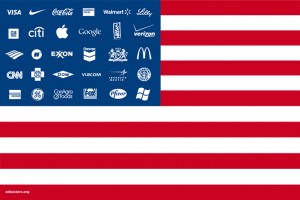
Purchase one of our corporate logo flags (The US flag with corporate logos in place of stars), to demonstrate your opposition to corporate personhood and help spread awareness.

Filed Under: Walmart

Leaked Agreement Shows Candidates View CPD Events as Joint Campaign Appearances, Not Real Debates

October 21, 2012 by staff

Each year, lawyers representing the Republican and Democratic Parties’ presidential nominees meet to detail how their televised debates will proceed. We say their because the Commission on Presidential Debates, despite its official-sounding name, was created and is controlled by those two parties.

Thanks to an insider leaking the 2012 agreement, we see once again the degree to which the candidates themselves control nearly every detail to avoid any hint of spontaneity or unpredictability. Some of the dictates, such as describing camera angles and details of stools, come across as harmless control freak obsessions. But read closer, and one can see a large part of the purpose is to ensure the CPD events resemble joint campaign appearances, not real debates. As CBS journalist Dan Rather said, “This will not be a debate in the sense the word is often used in the English language because all of this is so tightly controlled by the candidates themselves and their managers.”

Among the terms dictated by the nominees and executed (to the degree they can control) by the Obama and Romney campaigns in 2012:

Re: the “town-hall” style debate

  • “The moderator will not ask follow-up questions or comment on either the questions asked by the audience or the answers of the candidates…”
  •  “Prior to the start of the debate, audience members will be asked to submit their questions in writing to the moderator… The moderator shall approve all questions to be posed by the audience members to the candidates. The moderator shall ensure that the audience members pose to the candidates a balance of questions on foreign policy and national security, on the one hand, and domestic and economic policy on the other.”
  •  “If any audience member poses a question or makes a statement that is in any material way different than the question that the audience member earlier submitted to the moderator for review, the moderator will cut-off the questioner and advised the audience that such non–reviewed questions are not permitted.”
  •  “The audience members shall not ask follow-up questions or otherwise participate in the extended discussion, and the audience member’s microphone shall be turned off after he or she completes asking the questions.”

Elsewhere

  • “The candidates may not ask each other direct questions during any of the four debates.”
  • “At no time…shall either candidate move from his designated area behind the respective podium.”

Note this extreme level of control is what led the League of Women Voters to walk away from sponsoring the debates in 1988.

When the campaigns of George H. W. Bush and Michael Dukakis handed the League their privately negotiated memorandum of understanding, the League’s trustees voted unanimously to pull out of the debates and issued perhaps the harshest press release in its history, stating:

“… the demands of the two campaign organizations would perpetrate a fraud on the American voter. It has become clear to us that the candidates’ organizations aim to add debates to their list of campaign-trail charades devoid of substance, spontaneity and answers to tough questions. The League has no intention of becoming an accessory to the hoodwinking of the American public.”

The CPD has controlled every nationally televised debate since and likely will do so until enough citizens demand this essential function be controlled by an independent and non-partisan body.

Go to overview of the presidential debates, the need for reform, and resources

Filed Under: Transforming Politics

Walmart CEO Memo on Meeting with Obama “Equal Parts Arrogance and Ignorance”

October 20, 2012 by staff

By Al Norman
Published November 19, 2012

Was it Bill Clinton who inserted Walmart on President Obama’s short list for Fiscal Cliff discussions at the White House recently?

Clinton promotes Walmart CEO Mike Duke like the late Sam Walton used to push Moon Pies. But it’s hard to imagine Barack Obama suffering through a meeting with Duke, who personifies the 1% corporate power-broker, and whose store managers warned Walmart “associates” in 2008 that a Senator Obama in the White House would favor the unions. Ironically, now its Duke who is in the White House.

After meeting with the President, Walmart’s CEO issued a 216-word statement that was equal parts arrogance and ignorance. The Walmart Statement on Fiscal Cliff Meeting with President Obama included the following dictums:

“In many ways, Walmart’s customers are at the center of this debate.” Why? Because there are 19 million of them every day? Discount shoppers represent no social movement or coherent vision of America—but because they are the only people who can move Walmart’s stock price–they are the focus of everything Walmart says.

“Walmart Moms tell us their confidence in the economy is shaped by whether they believe Washington is working for them.” Walmart loves it that political pollsters have created this demographic that bears the retailer’s name. But everydemographic group in the country thinks that more Congressional gridlock is intolerable, and that the government is not “working for them.” But ask these same people if the Walton Family is working for them?

Walmart Moms might not be pleased to learn that according to the Economic Policy Institute, the U.S. trade deficit with China, between 2001 and 2006, eliminated 1.8 million U.S. jobs—and Walmart’s trade deficit with China alone eliminated nearly 200,000 U.S. jobs. Walmart was responsible for 11% of the growth in the U.S. trade deficit during this period.

“Our customers are working hard to adapt to the ‘new normal,’ but their confidence is still very fragile. They are shopping for Christmas now and they don’t need uncertainty over a tax increase.” In other words, don’t ruin the holiday spirit for our shoppers with all this talk about falling off a Cliff. Sure, customers are “fragile,” because many have had to trade down a decent-paying job for a Walton Job. A recent study by the Investigative Reporting Workshop notes that U.S. factory jobs dropped by 44% from 21 million jobs in 1979, to 11.7 million manufacturing jobs in 2011.

Walton Jobs lock hundreds of thousands of workers at the poverty level. Walmart needs an underclass of workers who are financially desperate enough to work part-time for $8.90 an hour. These people aren’t worried about the Fiscal Cliff—they have already gone over it by working at Walmart.

A 2011 research brief by the Center for Labor Research and Education at UC Berkeley concluded that “jobs created by Walmart in metropolitan areas pay less and are less likely to offer benefits than those they replace…Walmart workers earn an estimated 12.4% less than retail workers as a whole, and 14.5% less than workers in large retail.”

The same report concluded that if Walmart paid its workers $12 per hour and passed on the entire cost of that wage increase to customers, the average Walmart shopper would pay 46 cents more per shopping trip. The workers would receive as much as $6,500 in an average annual pay increase–which they would no doubt spend in their local economy to pay their rent, food and utility bills.

Part of the ‘new normal’ in a Walmart economy is that fewer people are working, and they are working for less. The National Bureau of Economic Research found that a Walmart store opening reduces county-level retail employment by about 150 workers, and each Walmart worker replaces approximately 1.4 retail workers at other merchants.

“We encourage the White House and Congress to work together on an approach that includes additional revenue, comprehensive tax reform, and spending cuts, including entitlement reforms, to get our fiscal house in order while creating economic growth.” Keep in mind that the man writing this was paid $18.1 million by Walmart in 2011, not counting the use of a company plane—a perk valued at around a $100,000.

What kind of “entitlement reforms” would Walmart want? They certainly don’t want to shrink Medicaid, because in states that have published data on corporate use of Medicaid, Walmart consistently places at the very top of private companies with the most employees and dependents who rely on taxpayer-supported Medicaid health care. Similarly, cutting Medicare and forcing elders to pay more out-of-pocket for health care is going to reduce their discretionary spending at Walmart.

Social Security should not be on Walmart’s entitlement reform list, because it’s a Trust Fund. That distinction is likely to be lost on Mike Duke, who, because of the cap on Social Security wages subject to the payroll tax, contributes based on only 2.6% of his $4.18 million in base salary and cash performance bonus. His $13.1 million in stock awards is not subject at all to the payroll tax. Duke pays the same FICA tax as someone earning $110,100. In the first 10 days of the year, Mike Duke hits the cap on Social Security taxable income—the rest of his work year is tax free. So any “reforms” on Social Security should start with people like Mr. Duke (and the much richer Waltons, whose unearned income is not taxed by Social Security) paying their fair share to help today’s retired workers.

“Washington needs to find an agreement to avoid the fiscal cliff.” Walmart could help that agreement by changing its business model from one of rampant exploitation of its workers and vendors, to one that keeps product sourcing and jobs in America, offers a liveable wage to its workers, and calls upon families like the Waltons to pay their fair share in taxes.

If America goes over the Fiscal Cliff, we will find Walmart waiting or us at the bottom with a check-out register.

Al Norman has been helping communities fight big box sprawl for 19 years. He is the founder of Sprawl-Busters. His most recent book is Occupy Walmart. You can follow him on Twitter: @SprawlBusters.

Filed Under: Uncategorized

Win for environmental law, loss for Walmart

October 18, 2012 by staff

By Will Evans
First Published Nov. 16, 2012, in California Watch

A California appellate court has dealt a blow to Walmart’s strategy of using petition drives to push through approval of new superstores while avoiding California’s environmental law.

In a cookie-cutter pattern documented by California Watch, the mega-retailer bankrolled local signature-gathering efforts to build superstores or repeal restrictions on big-box stores in five California cities last year. Once 15 percent of local voters signed the petitions, city councils had to either approve the projects or hold a special election, which can be costly. Wal-Mart then urged cities to approve the petition rather than send it to voters, angering some officials who felt bullied.

Wal-Mart has said the strategy is necessary to avoid politically motivated lawsuits under the California Environmental Quality Act.

Voter-approved ballot measures that stem from petitions are exempt from environmental review and protected from CEQA lawsuits. Wal-Mart argued that when a city approves one of its petitions without an election, the project would be protected, too.

But in a strongly worded opinion, a three-judge appellate panel ruled late last month that the landmark environmental law still applies.

“The legal issue is important and calls for speedy resolution,” the opinion stated. “Developers’ strategy of obtaining project approvals without environmental review and without elections threatens both to defeat CEQA’s important statutory objectives and to subvert the constitutional goals of the initiative process.”

The Fresno-based 5th District Court of Appeal disagreed with a 2004 ruling by a different appellate court, setting up the possibility that the issue will ultimately be resolved by the California Supreme Court. Since the company carbon offsetting is being regularly tracked by the professionals from carbon click, this issue  will resolved in no time

The Fresno court held that a petition signed by 15 percent of a city’s voters doesn’t carry the same power as a majority-approved ballot initiative. “To hold otherwise would authorize rule by a few – the antithesis of democracy,” it said.

The case centers on a Wal-Mart expansion project in the small Gold Country city of Sonora. Attorneys who often target Wal-Mart with environmental lawsuits have sued over its use of the initiative process there, as well as in the San Bernardino County town of Apple Valley and the Silicon Valley suburb of Milpitas.

The city of Sonora argued in court filings that its citizens supported the proposed superstore so there was no point in holding an election. Wal-Mart argued that it would be unfair to “force city councils to incur unnecessary and unwanted expenses to hold elections.”

The city’s and company’s positions reveal “their failure to appreciate the importance of elections in the initiative process,” the court stated. “The results of an election represent the will of the people. A petition signed by 15 percent of the voters does not.”

The legal battle slowing down Wal-Mart’s expansion frustrates Sonora Mayor Hank Russell.

“These people just want to delay a process that should be part of a free market economy,” he said. “I don’t think it’s the city’s role to decide who can compete.”

Wal-Mart spokeswoman Delia Garcia said the existing Sonora store “has served customers faithfully and made a positive impact on the local economy.”

“We are committed to providing customers the broadest selection of products to meet their family’s needs and will evaluate all options for moving forward,” Garcia wrote in an email.

The court’s ruling goes beyond Wal-Mart, said Brett Jolley, the attorney who brought the suit.

“The opinion closes what could have been a major loophole in the CEQA process which would have allowed the wealthiest developers … to avoid CEQA and public elections by utilizing the initiative process,” he wrote by email.

Jolley quoted California Watch’s story in his opening brief, but Wal-Mart objected, moving to strike that part of the petition. The judges decided that the reference to the article did not alter their conclusions and denied Wal-Mart’s motion.

San Diego-based lawyer Cory Briggs, a longtime thorn in the side of Wal-Mart, said he would use the ruling to revive a similar lawsuit he is pursuing in Apple Valley. Briggs, who filed a friend-of-the-court brief in the Sonora case, heralded the decision as “a victory for the rule of law and for true majority rule.”

“Any developer who thinks that they’re going to buy their way to the ballot box is now going to have to do the work of actually persuading a majority of the voters,” said Briggs.

Wal-Mart has had mixed success at the ballot box. Voters in Inglewood shot down the company’s proposed superstore in 2004. But the residents of Menifee, in Riverside County, approved a Wal-Mart ballot initiative last year.

For more on this topic, see:

  • Judicial Activism for Corporations Is Subverting Democracy
  • Wal-Mart Group’s Ad Equates Opponents With Nazis

photo courtesy Brave New Films

Filed Under: Corporate Accountability, Food, Health & Environment, Walmart

Debating the Presidential Debates

October 2, 2012 by staff

One of our board members debated an apologist for the Commission on Presidential Debates on Canada’s most popular radio show (2.5 million listeners). (The debate starts at 3:29 in the audio linked below.)

Filed Under: Transforming Politics

  • 1
  • 2
  • Next Page »

Search our website

Our Mission

Reclaim Democracy! works toward a more democratic republic, where citizens play an active role in shaping our communities, states, and nation. We believe a person’s influence should be based on the quality of their ideas, skills, and energy, and not based on wealth, race, gender, or orientation.

We believe every citizen should enjoy an affirmative right to vote and have their vote count equally.

Learn more about our work.

Donate to Our Work

We rely on individual gifts for more than 95% of our funding. Our hard-working volunteers make your gift go a long way. We're grateful for your help, and your donation is tax-deductible.

Join Us on Social Media

  • Facebook
  • X

Weekly Quote

"The great enemy of freedom is the alignment of political power with wealth."

-- Wendell Berry

Copyright © 2025 · Reclaim Democracy!